Scones

I’ve been watching every episode of The Great British Bake Off, and it has really inspired me to bake (even more). I tried Paul Hollywood’s (one of the judges in the program) recipe for scones, and they were really nice. But for some reason they rose funny. 😦 I did everything correct, didn’t twist the cutter and didn’t brush beaten egg on the sides, and yet only a few turned out OK and looked like scones. Well, they were tasty anyway so I just have to keep practice and see what I did wrong.

The best one!

Paul Hollywood’s scones, about 20

500g plain flour

80g softened butter

80g caster sugar

2 eggs

5 tsp baking powder

250 ml milk

1 egg, beaten with a pinch of salt, for glazing

Preheat the oven to 200C, put parchment paper onto a baking tray.

Put 450g of the flour into a large bowl and add the butter. Rub the flour and butter together with your fingers to create a breadcrumb-like mixture. Add the sugar, eggs and baking powder and use a wooden spoon to turn the mixture gently. Make sure you mix all the way down to the bottom and incorporate all of the ingredients. Add half of the milk and keep turning the mixture gently with the spoon to combine. Then add the remaining milk a little at a time and bring everything together to form a very soft, wet dough. (You may not need to add all of the milk.) Sprinkle most of the remaining flour onto a clean work surface. Tip the soft dough out onto the work surface and sprinkle the rest of the flour on top. The mixture will be wet and sticky. Use your hands to fold the dough in half, then turn the dough 90 degrees and repeat. By folding and turning the mixture in this way, you incorporate the last of the flour and add air. Do this a few times until you’ve formed a smooth dough. Be careful not to overwork your dough.

Next roll the dough out: sprinkle flour onto the work surface and the top of the dough, then use the rolling pin to roll up from the middle and then down from the middle. Turn the dough by 90 degrees and continue to roll until it’s about 2.5cm thick. ‘Relax’ the dough slightly by lifting the edges and allowing the dough to drop back onto the work surface. Using a pastry cutter, stamp out rounds from the pastry and place them onto the baking tray. Dip the edge of the pastry cutter in flour to make it easier to cut out the scones without them sticking. Don’t twist the cutter – just press firmly, then lift it up and push the dough out. Once you’ve cut 4 or 5 rounds you can re-work and re-roll the dough to make it easier to cut out the remaining rounds. Any leftover dough can be worked and rolled again, but the resulting scones won’t be as fluffy.

Place the scones on the baking tray and leave them to rest for a few minutes to let the baking powder work. Then use a pastry brush to glaze them with the beaten egg and salt mixture. Be careful to keep the glaze on the top of the scones. (If it runs down the sides it will stop them rising evenly.) Bake the scones in the middle of the oven for 15 minutes, or until the scones are risen and golden-brown.

Pink meringues

After watching an episode of Rachel Allen: Bake where she baked meringues, I was inspired to use up the egg whites I had left in my fridge. Her recipe was really good, they turned out crispy on the outside and chewy in the middle.

Pink meringues

4 egg whites

a pinch of salt

300 g caster sugar

1/2 tsp vanilla extract

a drop or two of red food colouring

Whisk the egg whites and salt into soft peaks with an electric whisk on high speed, add the sugar bit by bit and whisk until the mixture is quite solid and don’t fall out when you turn the bowl over. Add the vanilla and food colouring. Either mix the food colouring in well, so the mixture is evenly pink or just mix it in a little to get a rippled effect. Put spoonfuls of the mixture onto parchment paper and bake for 45 minutes in 140C. Then turn off the oven and put the oven door ajar and leave them to cool for 20 minutes.  

Madeleines take 2

In the second round of the quest for the perfect Madeleines, Christopher is the one baking. They have started a bake off in his office, and these were his contribution.

The recipe is from the book How to eat in by Adam Byatt, the chef at Trinity, one of our favourite restaurants. We were actually a bit disappointed with the recipe… Just like the last recipe we tried, the cakes are lovely, light and fluffy, but they don’t taste like perfect Madeleines should. We think they need more vanilla to them, and maybe more butter too, even though there is plenty in this recipe. The quest continues.

Has anyone got a great recipe we could try?

Madeleines, about 25

1 vanilla pod

400 g plain flour

2 tsp baking powder

400 g butter

9 eggs

450 g caster sugar

35 g clear honey

Preparation: Split the vanilla pod in half lengthways and scrape out the seeds. Sift the flour and baking powder together in a bowl. Roughly dice the butter and melt it in the microwave or in a bowl over simmering water, making sure it dies not get too hot. Remove the bowl from the pan.

Brush the cups of your moulds with soft butter, then dust them with flour, place in the fridge to get cold.

Method: Put the eggs, sugar and honey into a bowl. Add the vanilla seeds and beat well with a wooden spoon or an electric mixer until evenly mixed. Now add the flour and baking powder and continue mixing until well incorporated. Add the melted butter and incorporate further. Transfer the mix to a clean bowl, place in the fridge and leave to rest for at least an hour (up to 2 days).

When you are ready to bake the Madeleines, preheat the oven to 200C/180C fan/gas 6. Spoon the mixture into the cups, filling them three-quarters full, and bake for 12 minutes, until they become firm to the touch. Remove the moulds from the oven and allow to stand for 1 minute before turning the Madeleines out of the cups and dusting them with icing sugar.

Crumbly vanilla cookies with cornflakes and chocolate

I seem to spend every Sunday in the kitchen lately, and I absolutely love it, although I nearly overdid it this Sunday with the slow-cooking casserole, eggs benedict for breakfast and baking in between. It was quite late when I got to sit down and I realised how tired I was. And happy! Cooking and baking really makes me happy. On Sunday I tried a few new things, and fairly complicated recipes, but sometimes making a simple weekday dinner can make me just as happy. Or baking an old favourite recipe that I know by heart…

This cookie is related to the crumbly vanilla cookie I mentioned not too long ago, and it is really yummy. I can’t really say which one I like the most, but this combination is more unusual and the crunch from the cornflakes is great. Try them both and see which one you prefer! I promise, they’re both really good!

Crumbly vanilla cookies with cornflakes and chocolate, about 25

100 g softened butter

200 ml granulated sugar

100 ml rapeseed oil/cooking oil (one without strong flavours)

1 tbsp vanilla sugar

1 tsp cooking ammonium

400 ml plain flour

2 tbsp potato flour (can be excluded, just add a tad more wheat flour)

200 ml cornflakes

50 g dark chocolate, chopped

Beat the butter and sugar fluffy, beat in the oil. Mix in the other ingredients and spoon the mixture onto a baking sheet. It is quite stodgy and crumbly already here, so I help the mixture to stick together by pressing it into a ball with my hand as well. Bake for 13-15 minutes in the middle section of the oven in 175C.

Leave to cool on a wire rack, and if you want to make them look pretty, melt some chocolate and pour over them with a spoon to create lines. Leave to dry on the wire rack.


Chocolate oat balls

I liked to bake even as a little girl. I think I was eight or so when I made sponge better than my mum (that’s the only thing I can cook or bake better than her though, but it kept me going) and made it again and again for my dad, who had to eat a lot just to please me. This non-oven recipe I usually ate myself, and I still like it. It’s like a children’s truffle or something. It still helps against any chocolate cravings and it is so easy to make.

Pretty little things!

Chocolate oat balls, about 20

100 g softened butter

300 ml oats

4 tbsp granulated or caster sugar

1 tbsp cocoa

1 tbsp water

sugar strands, hundreds of thousands, desiccated coconut, chopped nuts etc.

Mix the ingredients thoroughly, the last thing you want is a lump of butter in there. I use the dough hooks on my electric whisk, otherwise you can do it by hand with a wooden spoon. Roll the mixture into small balls, and roll them in for example sugar strands or whatever you can think of. It is traditionally made with desiccated coconut, but I prefer it with something sugary. The white sugar pearls are Swedish, and that’s normally what I would use, but they look pretty with sugar strands or hundred and thousands too.

Put on a plate, cover with clingfilm and let them set in the fridge for at least 45 minutes. They keep for about a week in the fridge, but they usually don’t last that long. 🙂

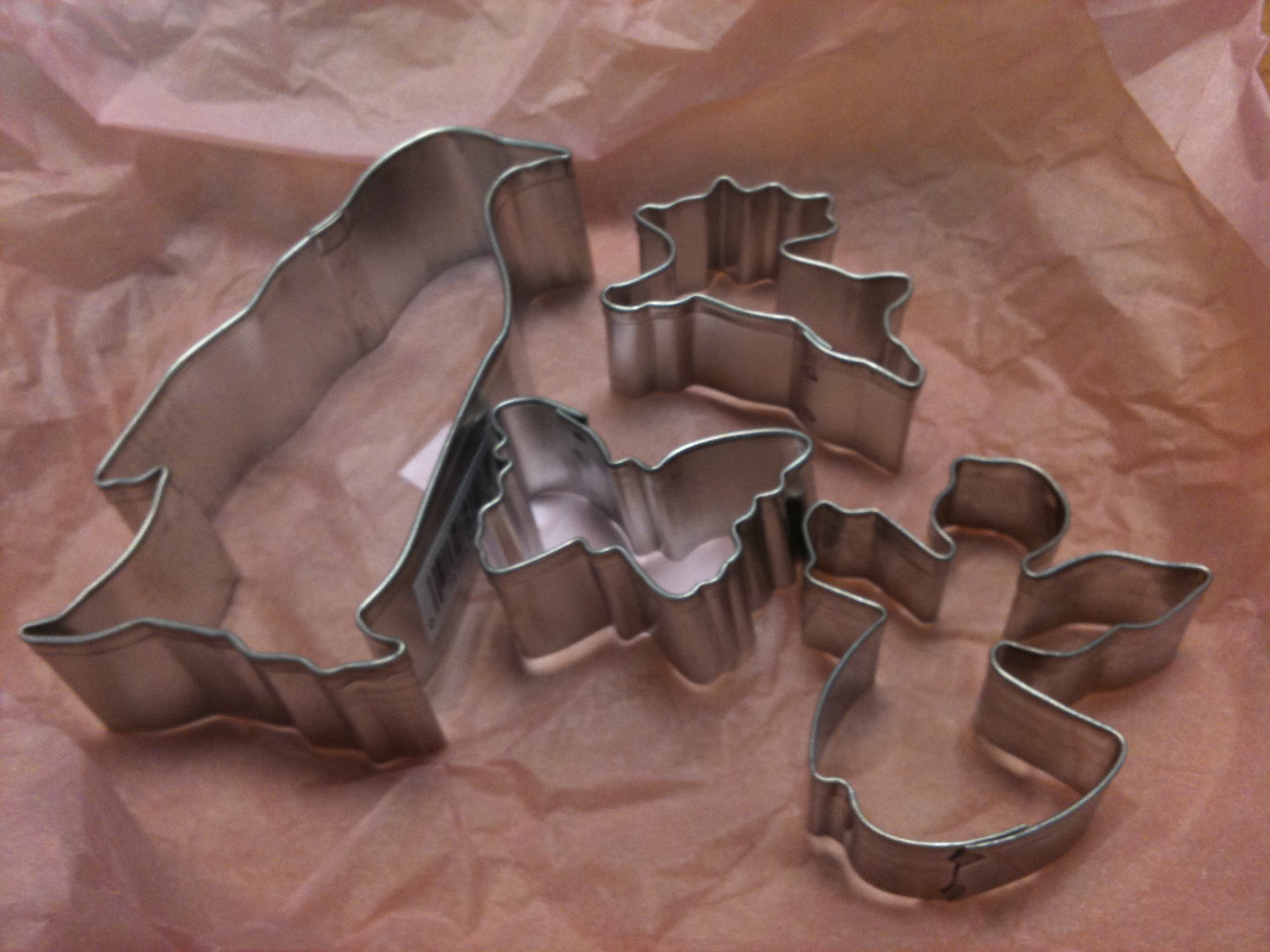
Cut out cookies

 Remember these?


They came to good use when I baked Nigella’s cut out cookies from How to be a domestic goddess.  It is the first time I’ve baked these type of biscuits, the only thing I use my cookie cutters for is ginger bread cookies once a year. It was a really good recipe, easy to make, easy to roll, easy to cut out and transfer to a baking sheet, and thankfully they were very tasty too. I will definitely make them again, and I know that for sure because I put half the dough in the freezer. 🙂

Cut out cookies, plenty

180 g softened butter

200 g caster sugar

2 eggs

1 tsp vanilla essence

400 g plain flour

1 tsp baking powder

1 tsp salt

Beat the butter and sugar fluffy, then add the eggs and vanilla. Mix the dry ingredients in another bowl and fold it into the mixture. Knead the dough in the bowl and add more flour if it feels too sticky. Cut the dough in half, wrap with clingfilm and put in the fridge for an hour (or freeze one half). Later roll out the dough on a flour-spinkled surface and make sure you sprinkle flour on the rolling pin too. I thought 2-3mm was a good thickness, but you can have the cookies thinner or thicker if you like. Transfer the cookies to a baking sheet and bake in 180C for 8-12 minutes. Leave to cool on a wire rack completely before icing them.

Icing

1 tbsp milk

royal icing sugar

Pour the milk into a bowl and add icing sugar little by little while whisking away until you have the consistency you like. Add some food colouring to make it more interesting.

Amazing pear cake

I think the girls yesterday will agree when I call this cake amazing! It just is and always has been… 😉

I got the recipe from a chef called Måns one summer when I was working in his café, where it also was a success. Hope you enjoy it too!

Pear cake

1 can tinned pears

2 eggs

300 ml granulated sugar

200 ml plain flour

150 g melted butter

Beat the eggs and sugar fluffy, fold in the flour and then the butter. Pour into a springform which is greased and coated with flour. Slice the pears and put them into the batter in a circle, and put some in the middle of the cake. Push the pear slices down as far as possible. Bake for about 30 minutes in 175 degrees. The cake should be a little runny in the middle. Serve with whipped cream flavoured by some vanilla sugar or St Germain. Enjoy!

Crumbly vanilla cookies

These crumbly cookies are called Drömmar (dreams) in Swedish. My grandmother used to bake these a lot (but another recipe) and serve them together with six other kinds of cakes and cookies when it was her or my grandfather’s birthday. It is old-fashioned Swedish tradition to serve 7 types of cakes and cookies in a specific order. It always started off with her cinnamon wreath (like cinnamon buns but shaped like a wreath and cut into pieces), then a type of sponge cake, then four types of smaller cookies, like these, followed by the grande finale – the cake. These parties were held in the afternoon and needed plenty of coffee and liqueur.

Crumbly vanilla cookies (Drömmar), 20

40 g softened butter

75 ml granulated sugar

3 tbsp cooking oil

200 ml plain flour

4 ml baking ammonia (hartshorn)

1/2 tbsp vanilla sugar

Put the oven on 200 C. Beat butter and sugar fluffy, then beat in the oil. Mix the dry ingredients and fold them in, make sure the batter is thoroughly mixed. Divide the batter into pieces and roll them into balls, carefully as the batter is quite crumbly. Put the balls onto parchment paper and turn the oven down to 175 C when putting the cookies in the oven. Bake for 10 minutes, leave to cool on a wire rack.

Oat crisps

This is neither a cookie nor a biscuit, but still something sweet to eat with your coffee, a ritual we in Sweden call fika. In my family we do it all the time! And this recipe is the best one I’ve ever come across on these crisps, havreflarn in Swedish, it is of course my mother’s recipe and the reason it is so great is because the outsides are very crisp and the middle is a bit chewy. You can eat them as they are, or roll them around a wooden spoon handle when warm to make them look fancy, stick one into a sundae, put vanilla ice cream or butter cream or whipped cream with vanilla in between two to make a sandwich, and all ways are good! 🙂

Oat crisps (Havreflarn), about 50

300 ml oats

200 ml granulated sugar

50 ml syrup

150 g melted butter

50 ml cream

150 ml plain flour

1/2 tsp baking powder

Combine all the ingredients and place dollops the size of a teaspoon on parchment paper on a baking tray quite far apart, they expand a lot in the oven. I only placed 9 on each sheet and that worked perfectly. Bake in 175 C oven for 8 minutes. Leave to cool on a wire rack.

Daim cookies

I think I had my first crush on Daim instead of a boy. We used to eat lots of daim bars at home when I was a child, and I loved them, but I didn’t have a crush on daim until I met daim icecream! OMG, it was sooo good! I still love it and everything with daim in it, and at the moment I might have a small crush on these cookies. They are so lovely I just can’t stop eating them.

Daim cookies, about 20

2 daim bars

300 ml plain flour

100 ml granulated sugar

1 tbsp syrup

1 tsp bicarbonate of soda

150 g softened butter

Chop the daim. Mix all ingredients in a bowl, add the daim last. Shape into a roll, about 5 cm in diameter. Dress in parchment paper and leave in the fridge for an hour. Cut the roll into 5 mm thick slices, place on parchment paper on a baking tray. Bake in 200 degree oven for 8 minutes.