Another recipe from the wonderful cookvook Plenty by Yotam Ottolenghi. This book is a good influence on me, I am eating more vegs than ever before. And I certainly needed someone to introduce vegetables in a fun way to me.
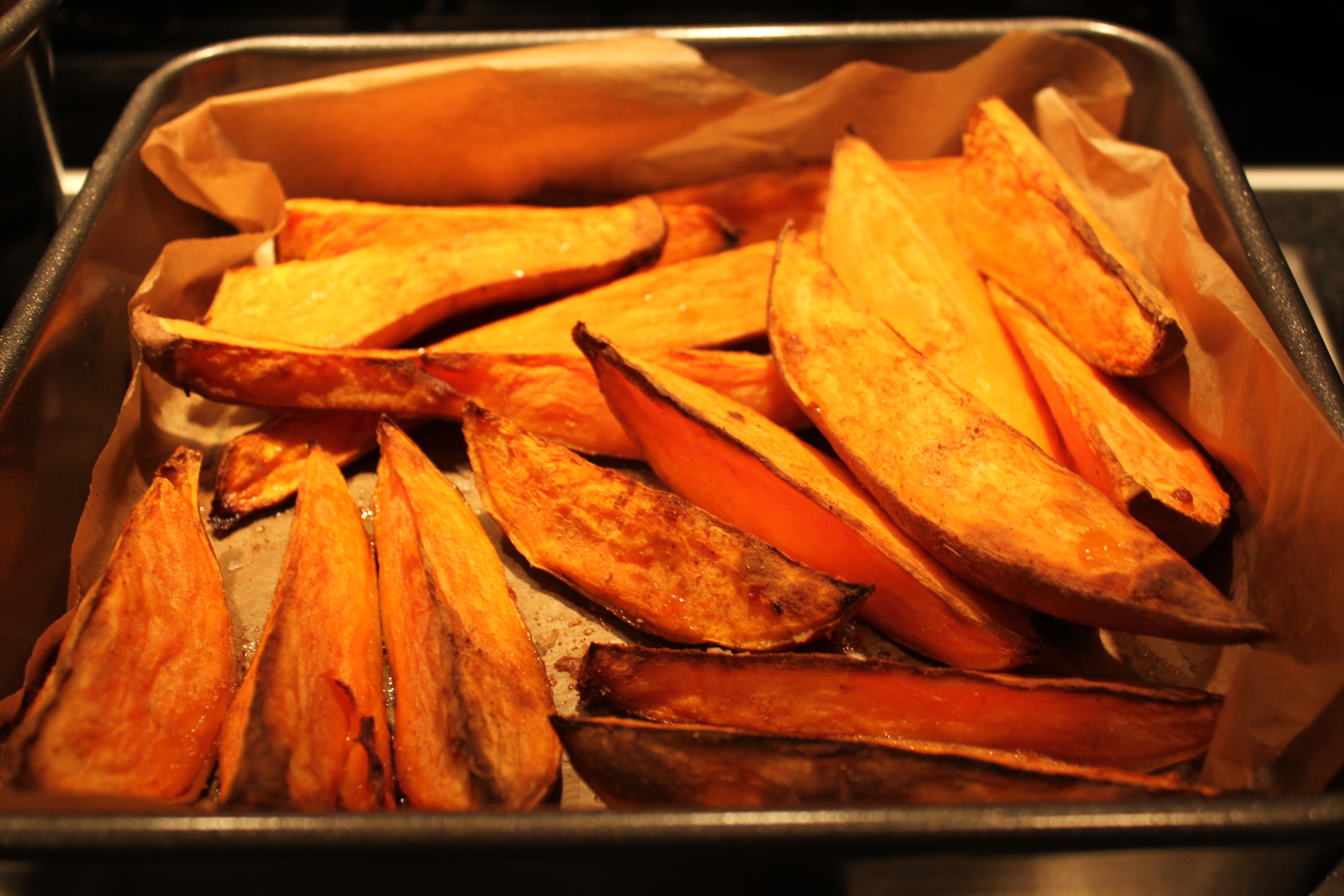
The combination of sweet potato and fresh lemongrass and the sharpness from the ginger really works. A marriage of flavours.
Simple, but yet so good.
Ottolenghi’s sweet potato wedges with lemongrass creme fraiche
900 g sweet potatoes
salt
ground coriander
Sauce:
200g creme fraiche
1/2 lemongrass
50 g grated fresh ginger
juice and zest from 2 limes
salt
For serving:
finely sliced red chilli
chopped fresh coriander
Wash the sweet potatoes but do not peel them. Cut every potato in 8 wedges. Cover an oven tray with baking parchment and brush with oolive oil. Add the sweet potatoes and brush them too with olive oil. Sprinkle salt and ground coriander on top. Bake in a preheated oven on 210C for 25 minutes.
Chop the lemongrass very finely and mix with the other ingredients for the sauce. Let it mull while the sweet potatoes cook. When serving sprinkle chilli and coriander on the sweet potatoes. Serve with the sauce on the side.
I love the weather here in London at the moment; it is around 20C, bright sunshine and clear blue sky. Only downside is the hay fever that comes with it (stupid plane trees!) but I love it anyway.
And when it is warmer temperatures I crave lighter food. More vegetarian dishes, fish and less heavy meat (even though I would never say no to a rare steak) and a perfect cookbook for inspiration is Ottolengi’s Plenty. I heart Plenty. After just cooking one recipe from it.
These leek fritters blew us away and although they generate quite a bit of washing up, they are worth the effort. The combination of spices works sooo well together and the garlic strong sauce with coriander and lemon is perfect to go with it. Yotam Ottolenghi sure knows what he is doing! Try this or regret it forever…
Leek fritters, serves 4
450 g leeks, trimmed
5 shallots, finely chopped
150 ml olive oil
1 red chilli, deseeded and sliced
25 g parsley, finely chopped
3/4 tsp ground coriander
1 tsp ground cumin
1/4 tsp ground turmeric
1/4 ground cinnamon
1 tsp sugar
1/2 tsp salt
1 egg white
120 g self-raising flour
1 tbsp baking powder
1 egg
150 ml milk
55 g unsalted butter, melted
Sauce:
100 g Greek yoghurt
100 g soured cream
2 garlic cloves, crushed
2 tbsp lemon juice
3 tbsp olive oil
1/2 tsp salt
20 g parsley
30 g coriander
Start by making the sauce. Blitz all the ingredients together in a food processor [or with a stick blender] until a uniform green. Set aside for later.
Cut the leeks into 2 cm thick slices, rinse and drain dry. Sauté the leeks and shallots in a pan with half the oil on a medium heat for about 15 minutes, or until soft. Transfer to a large bowl and add the chilli, spices, sugar and salt. Allow to cool down.
Whisk the egg white to soft peaks and fold it into the vegetables. In another bowl mix together the flour, baking powder, whole egg, milk and butter to form a batter. Gently mix it into the egg white and vegetable mixture.
Put 2 tbsp of the remaining oil in a large frying pan and place over a medium heat. Spoon about half the vegetable mixture into the pan to make four large fritters. Fry them for 2-3 minutes on each side, or until golden and crisp. Remove to kitchen paper and keep warm. Continue making the fritters, adding more oil as needed. You should end up with about eight large fritters. Serve warm, with the sauce on the side or drizzled over.
If I see something unusual or interesting food wise, I usually can’t resist the urge to buy it. So when I saw these pheasant eggs at Daylesford Organic on Saturday, I just had to buy them. They also had the more common duck eggs and quail eggs, which I have tried before, but pheasant eggs were new to me.
The eggs are quite small (but a lot bigger than quail eggs), the shell is grey and hard compared to regular hen eggs. The flavour was a bit different too, even though it tasted like eggs. But if you compare chicken to wild birds and do the same thing to the eggs, then you can figure out what it tastes like.
Asparagus with poached pheasant egg, serves 2
8-10 green asparagus spears
2 pheasant eggs
white wine vinegar
butter
salt
truffle oil
Break off the ends of the spears. Place in a pan and cover with boiling water. Add salt. Cook for a few minutes until they are ‘al dente’. Drain. Fill another pan with boiling water and 1/10 vinegar. Set the heat so that it is simmering. Break one egg into a mug/cup and lower it into the simmering water. Cover with a lid and take out the egg after 2 minutes. Transfer to a bowl with cold water. You can either poach both eggs at the same time – break the eggs into different cups and lower them into the water after each other, or poach them one by one. While the eggs are poaching, heat up some butter in a skillet and fry the asparagus for a couple of minutes. Divide between two plates, add salt, place the egg on top and drizzle truffle oil on top.
I like buying fresh fish, and a reasonably priced fish here in the UK is the rainbow trout. I buy most my groceries from Ocado, and trough them you can buy fresh fish prepared on the day by their fishmonger. Perfect! I love the trout fillets with the skin on, I think they taste great but they are also easier to cook. I just panfried the fillets and served them with ovenbaked beetroots, summery potatoes with parsley and a deep yellow hollandaise. I have started to buy freerange eggs from a friend of a friend’s farm, and they have a deep yellow yolk. Best eggs ever!
Rainbow trout with parsley potatoes, baked beetroots and hollandaise sauce, serves 2
2 rainbow trout fillets with the skin on
persillade
5-6 potatoes (Maris piper)
a knob of butter
2 tbsp chopped parsley
2 fresh beetroots
olive oil
Sauce:
2 egg yolks
100 g salted butter
1 lime
1 tsp vinegar
salt, white pepper
Peel the beetroots and cut into wedges. Place in an ovenproof dish, add olive oil, salt and pepper. Bake for 1hr in 200C or until soft. Peel the potatoes and cut into 2-3 mm thick slices. Rince, put in a pan and cover with water. Add salt. Bring to the boil. Drain. Place in an oven tray, add dollops of butter (approx 2 tbsp) and chopped parsley. Bake until soft and golden, 200C, about 30 mins.
Melt the butter and leave to cool a little. Mix vinegar, lime juice and egg yolks in a sauce pan.
Fry the trout fillets skinside down in oil/butter until the meat around the sides seems cooked. Turn over and fry on the other side for a few minutes. Place skinside down again. Sprinkle persillade on top and squirt some lime juice. Turn off the heat.
Skala rödbetorna och skär i klyftor. Lägg i en form, häll på olivolja, salt och peppar. Baka 1h 200 grader. Skala potatisen och skär i 2-3 mm tjocka skivor. Skölj, lägg i en kastrull, täck precis med vatten, salta. Koka upp. Häll av vattnet. Fördela i en form. Klicka över smör (ca 2 msk) och strö över persilja. Baka tills mjuka och gyllene, 200 grader ca 30 minuter.
Smält smöret och låt svalna lite. Blanda vinäger, limesaft och äggulor i en kastrull.
Stek forellfiléerna med skinnsidan neråt i olja/smör tills kanterna ser genomstekta ut, vänd och stek andra sidan. Vänd igen, pressa över lite limejuice och strö å lite persillade och vitpeppar. Turn off the heat.
Put the sauce pan in a double boiler or on a very small flame. Whisk while adding the butter little by little until it is all incorporated. Be careful not to get the sauce too hot, and don’t stop beating as the sauce might split. Season with salt and pepper.
On Monday I tried to cook pork fillet en croûte again, and this time it was absolutely perfect, if I may say so myself. Christopher liked the flavours, but he had preferred to roll the bacoon around the fillet and have smaller pieces of mushrooms. I liked it just the way it was, and like that there are larger pieces of bacon and mushrooms. But I will try his version next time.
Pork fillet en croûte with bacon, button mushrooms and thyme, serves 4
400 g pork fillet
375 g ready-rolled puff pastry
100-150 g button mushrooms
6 slices streacky bacon
3 sprigs thyme
1 egg, beaten
salt, pepper
Cut the bacon into pieces and fry it until crisp. Drain on kitchen towel. Slice the mushrooms and fry them on high heat in the same pan, in some butter and olive oil. Season. Mix bacon and mushrooms and leave to cool completely. Mix in the thyme leaves.
trim the pork fillet. Roll out the pastry and distribute the bacon and mushrooms all over it, keeping the edges free. Season the meat and place in the middle. Roll tightly and nip in the edges. Place in a greased roasting tin, brush with the beaten egg. Place a meat thermometer in the thickest part of the meat. Place in 200 C oven and cook until the temperature is 62C. Leave to rest a few minutes before slicing.
Parsnip purée, serves 4
1 kg parsnips
milk
butter
salt, white pepper
Peel and cut up the parnsips. Rinse and place in a large pan. Just about cover with milk. Season. Bring to the boil and let it cook on low heat until soft. Drain but keep the milk. Purée the parsnips with a stick blender. Add butter and some milk if needed. Season.
I’m trying to get better at not wasting food. I am actually pretty good, but there is always room for improvement.
So I saved the lobster shells from NYE to make stock wihich I then reduced and froze as ice cubes. I also made stock from the wild ducks, which I reduced even more and froze as well, but I was exceedingly clumsy and dropped the tray and lost half of the stock. The same evening I also broke a china bowl. 😦
Lobster stock
the shell from two lobsters
1 large carrot
1/3 fennel
1 onion
some peppercorns
1 tbsp tomato paste
a few sprigs of parsley
1 garlic clove
olive oil
Rinse the shells thoroughly. Cut into smaller pieces. Fry with the vegetables in olive oil to get more flavours out. Cover with water. Add the spices, herbs and tomato paste. Bring to a boil and continue to cook until about half the water remains. Strain and pour back into the pan. Add some salt and reduce until you have the concentration you would like. Leave to cool. Pour into ice cube trays and freeze. Put the cubes into a freezer bag and keep in the freezer.
The first time I learned about quesadillas was when I still lived with my parents and I saw Jamie Oliver on TV. His version was simple: soft tortillas + grated cheese + sliced spring onions + chopped red chilli + dry frying pan. They were delicious and since then I have made lots of different versions myself. But I have always always used a dry pan as he did.
Until I read on Pioneer Woman about how much better it is with quesadillas fried in plenty of butter. Nothing bad about Jamie, but I think I trust Ree in this one. 🙂 The same evening I madee some. Only because we had some tortillas left that needed to be eaten. I love when that happens, when I get given a reason to eat something yummy. 🙂
What I had at hand was fresh coriander, red chillies, grated gruyére and courgettes. And butter. It was sooo much better with butter!
Quesadillas fried in butter, with courgette, chilli and coriander
I won’t give you any measurements, just grab what you think will do. These are easy to throw together.
soft flour tortillas
grated strong cheese
chopped red chillies (seeds and membranes removed)
chopped coriander
courgettes
olive oil
butter
Slice the courgette finely and fry in oil until it is nice and golden. Add salt and pepper. Melt butter and some oil (to prevent the butter from burning) in a frying pan on medium heat. Put one tortilla in the pan. Add the cheese, chillies and coriander. Distribute the courgette and maybe add some more cheese. Put another tortilla on top and press it down with the palm of your hand. When the bottom tortilla is golden and crisp, turn the quesadilla around to fry the other side in more butter. This is the only tricky bit, because we don’t want the filling to fall pout. Turn it around using a plate or two spatulas. When golden and crisp on the other side too, cut into wedges and serve immediately, perhaps with some salsa and/or guacemole.
When I went home to Sweden for Christmas, my parents gave me three wild ducks to take back with me to London. Thank you! And it worked out really well to bring them back in the suitcase. They were frozen and wrapped in plastic and newspapers and hadn’t defrosted one bit by the time I got home. So these treasures became our main course on New Year’s Eve. First I browned them all around and then I put them in the oven together with fresh thyme, juniper berries and port. The meat juices went into a simple sauce together with cream and I served Hasselback potatoes, small carrots and a chicory gratin with it.
Wild duck with port and thyme, serves 4
3 wild ducks with the breasts on the body (I didn’t use the thighs)
olive oil
butter
100 ml port
fresh thymr
some juniper berries
Brown the ducks on all sides in butter and oil. Add salt and pepper. Pour over the port, add some juniper berries and some sprigs of thyme. Put a meat thermometer in the middle of the thickest part of the bird. Put the frying pan in the oven (make sure you use one without plastic handles) in 200C until the mat has an inner temperature of 62 degrees. Let the meat rest in tin foil while you get on with the sauce.
Carv the meat into slices before serving. I don’t know much (if anything about carving) but it seemed easiest to cut the around the breasts to loosen them from the body and then slice them up.
Creamy sauce, serves 4
the meat juices
300 ml cream
150 ml milk
maizena or other thickening granules
a splash of port
concentrated game stock
salt
white pepper
The meat juices tasted fabulous so you don’t need to add much to make a seriously nice sauce. Pour the meat juices through a sieve and into a sauce pan. Add milk, cream, maizena and bring to a boil. Season to tast with port, salt, pepper and stock.
Chichory gratin
chicory
single cream
salt
pepper
grated gruyére cheese
Wash the chicory. Cut off the stems. Put in a pan and cover with water for 1 hour to remove the bitter taste. Drain. Put back in the pan and cover with cream. Bring to a boil and cook on low heat until soft. Pour this into an oven dish. Add salt, pepper and cheese. Bake in 200C until golden brown on the top.
When it is winter and cold, I use every possible excuse to eat hearty comforting food. The creamier the better! But, it’s not exactly healthy… So this is a slightly healthier version of potatoes au gratin. But instead of just potatoes I have added a lot of different root vegetable. Make this your own by adding what you like. I will probably try it with Jerusalem artichokes next, just because I love them. 🙂 And by using less cream (still cream though, it wouldn’t be the same without) and adding some milk and flour to thicken, this is a little bit better for you than the ordinary potatoes au gratin. Still not as healthy as something without cream and cheese, but it is winter and cold and we deserve this, don’t you think?! 😉
Root vegetable gratin, serves 4
2 potatoes
2 carrots
1/2 celeriac
1 small swede
1 parsnip
10 cm leek, sliced
1 tbsp plain flour
200 ml single cream
200 ml milk
1 clove garlic, pressed
salt & pepper
thyme
100 ml grated cheese
Peel the root vegetables and slice them. Put them in a pan, cover with water. Add some salt and bring to a boil. Cook the vegetables for about 5 mins. Drain. Grease an oven dish with butter and distribute the vegetables and leek. Mix milk, cream and flour and add the garlic. Add some salt, pepper and thyme (dried is fine). Pour the mixture over the vegetables so it almost cover. Scatter some grated cheese on top. Place in 200C oven for 45 minutes. Serve with meat.
Last Monday the supper was a proper bull’s eye. I love when everything comes together like it was meant to be. We had a bottle of cider open from the night before and needed to use it up. I had defrosted some chicken thighs and had to do something with the butternut squash in the fridge, it needed to be eaten.
Chicken thighs are very tender as it is the darker meat on the chicken, but cooked like this it became even more tender. Lovely. The sauce which I used the cider for as well was just the perfect balance of creamy and comforting, sweet from the chilli sauce, sour from the cider and with a punch from the dijon. And the butternut squash. I could not have predicted how nice this would be. If I could, then I would have made this sooner, that’s for sure. The squash becomes very sweet and mushy when baked in the oven I wanted something fresh to contrast that, and it seemed like garlic, parsley, spring onions and parmesan was just the perfect combo. I will make this again and again and could eat half a butternut squash like this with some bread for lunch. Yu-um is all I can say. 🙂 Try this, ok??
I just served the pumpkin cut into large pieces. Very rustic. 🙂
Start with the butternut squash and then put some potato wedges in the oven, continue with the chicken and lastly the sauce. Most of it will take care of it self in the oven, so even though it seems like lots of ingredients and a few steps, it is very simple.
Cider chicken with creamy sauce and gratinated butternut squash, serves 2
The chicken:
2 chicken thighs with the skin on
olive oil
salt
white pepper
Persillade
dry cider
The sauce:
dry cider
the juice from the chicken
a splash of concentrated stock (vegetable or chicken)
2 tsp dijon mustard
1 tbsp Heinz chilli sauce, or similar
300 ml single cream
persillade
white pepper
salt
The butternut squash:
1/2 butternut squash
olive oil
salt
white pepper
1 clove of garlic, pressed
chopped fresh parsley
2 spring onions, chopped
grated parmesan
The squash: Wash the squash and cut it lengthways in half. Take away the seeds and membranes. Put in a dish, pour over some oil and season with salt and pepper. Bake for about 45 minutes or until soft in 200C. Chop spring onion and parsley and mix with the garlic. Sprnkle this on top of the butternut squash and add plenty of grated parmesan. Bake for another 10 minutes.
The chicken: Heat up olive oil in a frying pan that you can use in the oven later (no plastic handles that could melt) and sear the chicken all around until nice and golden. Season with salt, pepper and persillade. Pour in 2 cm of the cider and put the frying pan in the oven, 200C for 25-30 minutes. Check that the meat is cooked through. When done, wrap the meat in tin foil and let it rest while you make the sauce.
The sauce: Pour the juices from the frying pan into a sauce pan (or use the same frying pan if the cider hasn’t burned), add some more cider (about 100 ml) and let it reduce a little. Add cream, mustard and chilli sauce, and season add stock, perisllade, salt and pepper after taste. Bring to a boil and let it cook for a few minutes to thicken and for the flavours to develop.
Serve with potato wedges and maybe some steamed broccoli.



 Scandelights